
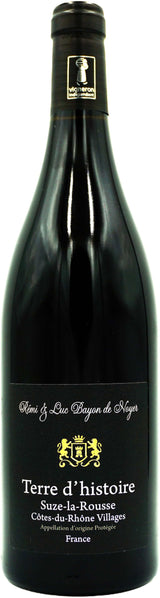



Remy et Luc Bayon de Noyer
Remi et Luc Bayon de Noyer, Terre d'Histoire, Suze la Rousse Cotes du Rhone Villages, 2025
RedLike a testimony of the Romain Empire's vestiges previously excavated from this parcel, Cuvee Terre d'Histoire extract the most noble aromatics from Syrah and its terroirs. With a sublime deep garnet color, the scents are fleshy, ripened, with concentrated dark berries, minerals, violet, light menthol, and elegant spices. On the palate, the minerality comes forward to bring a gentle touch to a lush array of blue and blackberries, plums, refreshing herbs and sage. The experience is lingering and would pair with any given occasion throughout the year. Astonishing and easy to share! Certified Organic by France’s standards. Vegan Wine, using tangential filtration for finning. Only sold by Celerier’s Cellar in the US.
Certified Organic by French standard. Double Cordon de Royat pruning in winter, 5 to 6 chandelles per vines, 2 buds per Chandelles which is a quarter less than traditional requirements (optimize natural concentration of nutriments with lower yield). Little ridging entry of winter and unearthing early in Spring. The grass is grown both naturally and seeded in 1 row out of 2. There is no plowing to leave a bed of hay to help mechanical work in the vineyard. It is also a natural protection against erosion. In spring, Grass is only cut around the vine base via inter vine hoes to gently plow their superficial roots and stress them to grow deeper ones. Density 4,000 vines per hectare (sand is poor in nutrients and is a natural challenge, no need for higher density), pruning of the superficial twigs (epamprage) by hand, but due to climate change and higher temperature, no need to remove leaves to keep the grapes in the shade and keep freshness in the wines. Disbudding and levelling done by hand in the Spring. Fully hand harvested with the newest technology for reactive and optimal harvests. All is set for waiting until the last minute to harvest grapes at peak maturity in cold conditions. The harvest lasts for a long time (6 days), starting by the varietal with earliest maturity to last.
Harvests are segmented by both varietals and parcels. Grenache is pressed in full cluster, while Syrah is fully destemmed. Maceration happens in stainless steel tanks for 3 days at cold temperature (13°C) to keep fresh aromatics. During that time, a single pump-over is done once a day for gentle extraction. After the 3 days maceration, the natural alcoholic fermentation starts with its indigenous yeast (while the must is still l. This fermentation generates CO2, which creates heat. They let the wine temperature rise to 24-25°C then keep it constant throughout the alcoholic fermentation. About 3 days after the beginning of the alcoholic fermentation, when the juices reach 1,040-1,050 g/ml density, Remi and Luc use a cane to introduce oxygen inside the liquid to stimulate the yeast’s natural growth. Altogether, the Alcoholic fermentation lasts for about a week. Daily treading (punch down once a day) allows extractions of softer tannins and prevents the wine marc oxidation by immerging it softly. This step takes place over 2 weeks. Meanwhile, Remi and Luc proceed with daily tastings for each batch to monitor the evolution of aromatics. When flavors are where they want them to be, Remi and Luc proceed with the devatting and separate the free run juice from the must. The latter goes through a gentle pressing to extract a press juice that will bring more structure to the wine. The pressed juice is blended with the free run one and put back into the stainless-steel tanks. Each tank contains the wine from the same parcel. The next step takes form in the spontaneous natural malolactic fermentation. It will last for 4 to 5 days. For the final step before bottling, the parcel wines are blended in concrete tanks to enhance and optimize the aromas from the terroir's minerality. This ageing process lasts 12 months. The wine is bottled in June, always in the waning moon cycle and before seasonal heat waves. Aging in bottle for 3 months before release.
Gravennes plateau, composed of an upper layer of clay limestone with gravels. Under layer of concentrated limestone from the Miocene Epoch with small shellfish fossils (23-5.8 million years BC). Deeper layers provide sandy Miocene and clay, excellent for the natural irrigation due to the adjacent river, the Leys. Ideal Exposition, East, South-East, South, which provides optimal sun exposure.